‘Except’: does the restriction apply to your car?
An exception under a traffic sign applies to a particular group or journey. Learn how cyclists, permit holders, and destination traffic differ so that one word does not lead you into a restricted road.

Step 1 — Read the main sign first. Its restriction is the starting point. Then identify which people or traffic the supplementary plate exempts.
Step 2 — Compare the named group with your vehicle. ‘Uitgezonderd fietsers’ (except cyclists) does not exempt an ordinary car. Whether any cyclists are currently present is irrelevant.
Step 3 — Check any permit requirement. ‘Uitgezonderd vergunninghouders’ (except permit holders) requires a valid permit applicable to that situation. Living nearby or remaining seated in the car is not a substitute.
Step 4 — For destination traffic (bestemmingsverkeer), assess the actual purpose of your journey. For the car journeys discussed here, this means a specific property on or near the restricted road that can only be reached via that road. A visit may qualify; an ordinary shortcut elsewhere does not.
Step 5 — Pay attention to the wording around symbols. A symbol alone limits the main sign to the indicated group. ‘Except’ alongside that symbol instead exempts the group. Read more than the picture.
Example 1 —  No entry from this end of a one-way road (C2) with ‘except cyclists’ stands at an entrance. Your ordinary car is outside the exempt group. You may not enter in that direction even when no cyclists are present.
Example 2 — 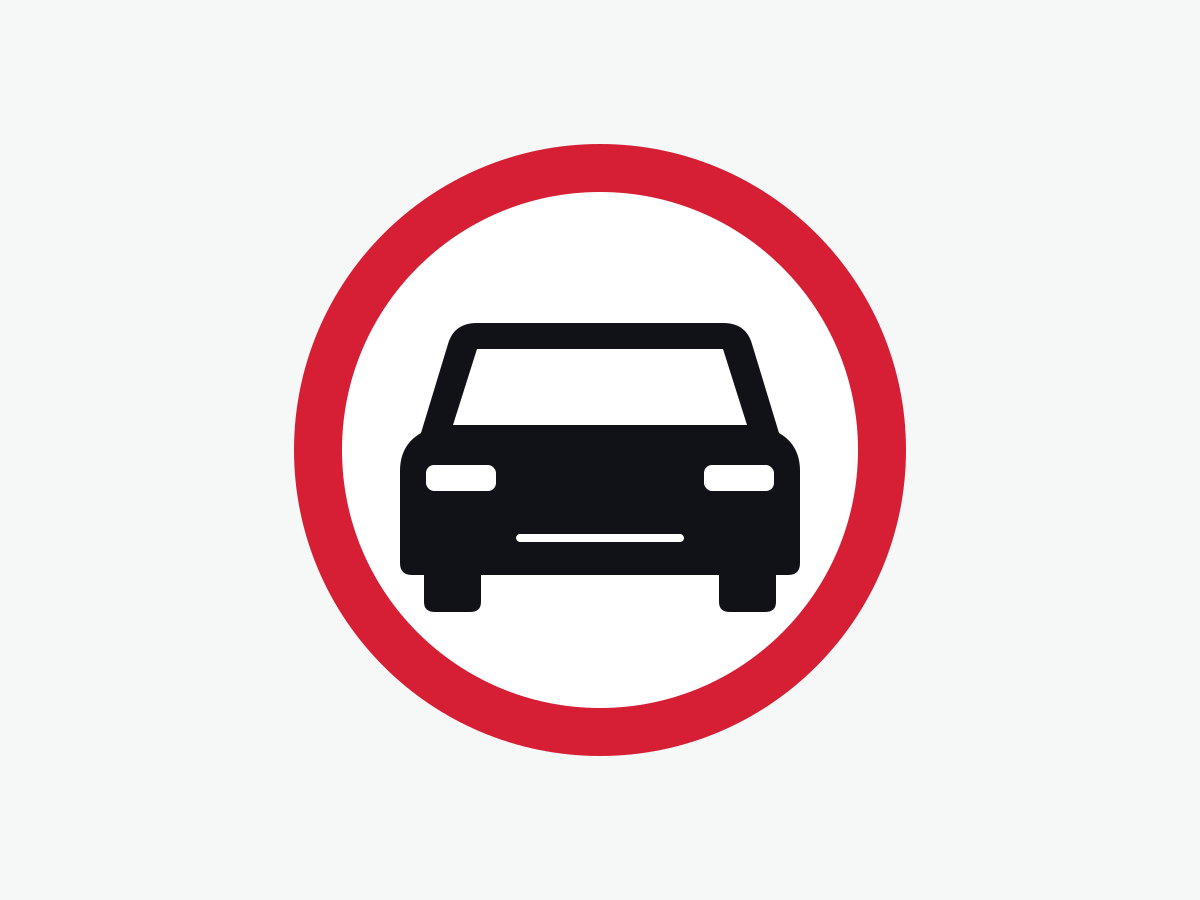 Closed to motor vehicles with more than two wheels (C6) with ‘except destination traffic’ restricts a road. You are visiting a house on it that can only be reached using that road. This destination can qualify your journey for the exception; you need not be a resident.
Example 3 — At the same Closed to motor vehicles with more than two wheels (C6) combination, you want to bypass a traffic jam on the way to another neighborhood. Your destination has another access route. Saving time does not make your journey destination traffic.
Summary — 1. Start with the main sign. 2. Check the exempt group. 3. Read ‘except’ literally. 4. Assess your permit or destination. 5. Continue following other rules.
FAQ — Am I destination traffic because I am going somewhere? Not for that reason alone. For these car journeys, your destination must meet the conditions concerning the specific property and its access.
FAQ — Are only residents destination traffic? No. A visit to a qualifying property reachable only through that road can also qualify. The legal definition additionally includes scheduled bus drivers.
FAQ — Does an exemption cancel other rules? No. It concerns the sign to which it is attached. It is not a general exemption from speed limits, priority rules, or safe driving.
Practice question 1 — You are driving an ordinary car. This entrance has the pictured sign and ‘uitgezonderd fietsers’ (except cyclists). May you enter here? A. Yes, after letting any cyclists pass first. B. Yes, if no cyclists are present at that moment. C. No, your car is not exempt. Check: C. No entry from this end of a one-way road (C2) closes this direction to vehicles. The supplementary plate exempts cyclists only, not your car. Yielding to cyclists or finding none present does not change which vehicles are exempt.
Practice question 2 — This sign stands at the start of a road. You are driving a car to visit someone living on that road. The house can only be reached via this road. Does the exemption cover this visit? A. Yes, this visit counts as destination traffic. B. No, only the residents themselves may enter the road. C. No, only vehicles holding a permit are exempt. Check: A. Destination traffic (bestemmingsverkeer) includes drivers visiting a property on or near the road that can only be reached using that road. You do not have to live there yourself. This plate does not state a separate permit requirement.
Practice question 3 — You want to use this road in your car to avoid a traffic jam. Your destination is in another neighborhood and can be reached by other roads. Does the plate exempt this journey? A. Yes, because every driver has a destination. B. No, this shortcut is not destination traffic. C. Yes, if traveling by other roads would take longer. Check: B. Simply having a destination is not enough. The legal definition concerns particular properties on or near the restricted road that can only be reached using that road. A shortcut to another neighborhood does not meet that condition.
Continue learning — Signs & road markings; Stopping & parking; Legal duties; Road position. These existing lessons are included in the internal references.
Next step — Take a mock exam (oefenexamen), reading the supplementary plate with every sign before deciding.