Timed parking signs: when does the restriction apply?
A supplementary plate (onderbord) can specify the days and hours when a parking or stopping restriction applies. Read the whole combination before stopping to avoid parking on the wrong day or a few minutes too early.

Step 1 — Identify the main sign. 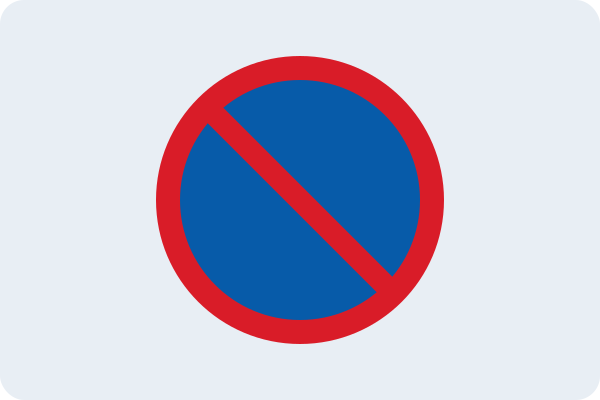 No parking (E1), with one red diagonal bar, prohibits parking.
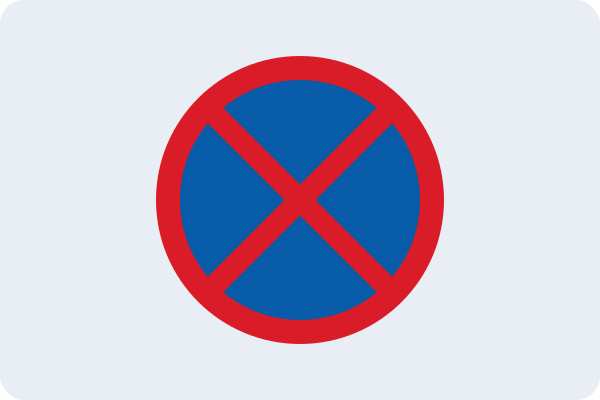 No stopping (E2), with a red cross, prohibits voluntary stopping, including letting a passenger get out immediately.
Step 2 — Read both days and hours. ‘Ma t/m vr 08–18 h’ means Monday through Friday, from 8 a.m. to 6 p.m. Both the day and the time determine whether the restriction is active.
Step 3 — Consider the entire parking period. Will the restriction start or end during your stay? A period partly within the restriction is not made lawful by the rest of the stay being outside it.
Step 4 — Check the side of the road and other rules. No parking (E1) and No stopping (E2) apply to the side where they stand. Outside the stated hours, other rules may still prohibit parking or stopping.
Example 1 — It is Saturday at 11 a.m. beside No parking (E1) with ‘ma t/m vr 08–18 h’. That time restriction is inactive. Next, check whether another rule restricts parking.
Example 2 — On Tuesday at 10 a.m., No stopping (E2) has the same time plate. You want to let someone get out immediately. That is voluntary stopping and is covered by the active restriction.
Example 3 — On Wednesday at 5:55 p.m., you want to park at No parking (E1) until 6:15 p.m. The first five minutes remain within the restriction. Its imminent end creates no exemption.
Summary — 1. Distinguish parking from voluntary stopping. 2. Read days and hours together. 3. Check your entire stay. 4. Identify the sign's side of the road. 5. Consider other traffic rules too.
FAQ — Does ‘ma t/m vr’ include Saturday? No; it means Monday through Friday. Read any separately listed Saturday hours independently.
FAQ — May I stop briefly at No stopping (E2) with the engine running? Keeping the engine running does not change voluntary stopping. It creates no exemption while No stopping (E2) applies.
FAQ — Is parking automatically allowed after the stated hours? No. This timed restriction is inactive, but other parking rules may still apply.
Practice question 1 — The pictured parking restriction applies along your side of the road. It is Saturday at 11 a.m. Does this sign and supplementary plate (onderbord) restrict parking at that time? A. Yes, the restriction also applies throughout the weekend. B. No, but other parking rules may still apply. C. Yes, only permit holders may park there on Saturdays. Check: B. The plate limits No parking (E1) to Monday through Friday from 8 a.m. to 6 p.m. Saturday is outside that period. It does not mention a permit-holder exemption. Other parking rules still need to be checked.
Practice question 2 — It is Tuesday at 10 a.m. You want to stop voluntarily on this sign's side of the road to let a passenger get out immediately. What applies here? A. This brief voluntary stop is also prohibited. B. A passenger may get out if you keep the engine running. C. A passenger may get out if you stop for less than a minute. Check: A. No stopping (E2) prohibits voluntary stopping, including letting a passenger get out immediately. Tuesday at 10 a.m. is within the stated period. Neither keeping the engine running nor stopping briefly creates an exemption.
Practice question 3 — It is Wednesday at 5:55 p.m. You want to park at this sign and return at 6:15 p.m. There are no other exemptions. May you start parking at 5:55 p.m.? A. Yes, because most of the stay would be after 6 p.m. B. No, the restriction still applies until 6 p.m. C. Yes, because the restriction ends within five minutes. Check: B. The beginning of your parking period would still fall within the restriction. Its imminent end or your later return does not make those first minutes lawful. Reassess whether parking is permitted after the restricted period ends.
Continue learning — Signs & road markings; Stopping & parking; Legal duties; Road position. These existing lessons are included in the internal references.
Next step — Take a mock exam (oefenexamen), reading the supplementary plate with every sign before deciding.