Microcars: small vehicles, distinct rules
Understand why a Dutch brommobiel is not a mobility scooter and how to interact safely as a car driver.
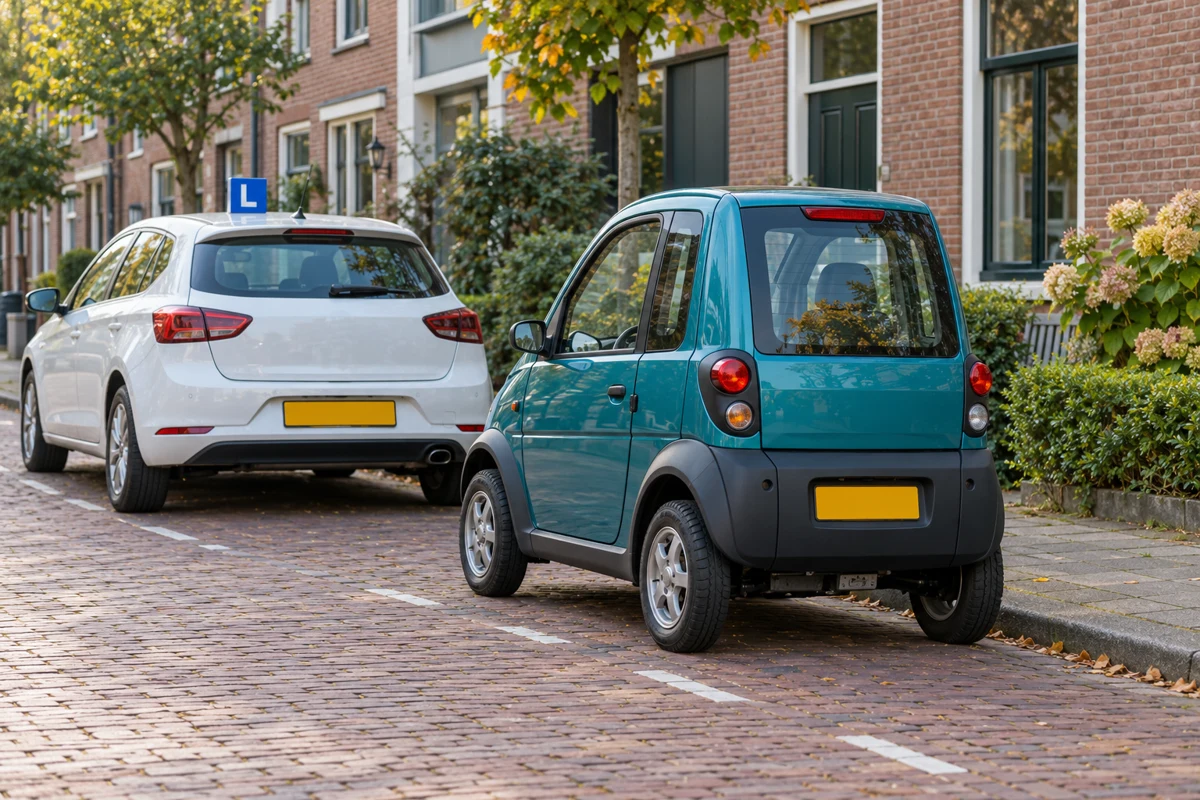
A Dutch brommobiel is a moped with more than two wheels and a body. It resembles a small car but belongs to a distinct category. It is not a disability vehicle. Motor-vehicle traffic rules generally apply unless a specific provision says otherwise.
A brommobiel uses the carriageway, not cycle tracks, combined cycle/moped tracks, footpaths or pavements. The moped-related name does not make it an ordinary moped that follows a cycle/moped track. Also read access prohibitions and supplementary panels.
The maximum speed is 45 km/h unless a lower limit applies. A 30 zone still means at most 30; a woonerf means at most 15. A brommobiel may be permitted on an ordinary 80 km/h road, but this does not allow it to travel at 80. Expressways and motorways are not permitted.
The driver must be at least 16 and hold AM or an AM licence restricted to microcars (AM4). A valid car or motorcycle licence also includes AM. The absence of a licence requirement for a mobility scooter does not extend to a brommobiel.
Third-party liability insurance is required. A brommobiel has a yellow moped registration plate at the rear, and the driver must carry its registration document. In an enclosed microcar, use the fitted seat belt. An open microcar without belts requires an approved helmet; the legal belt and helmet conditions differ from those for a mobility scooter.
As a car driver, recognise the speed difference early. Keep a gap and postpone overtaking where visibility is restricted. Small size or low speed does not change ordinary priority rules: a microcar from the right may go first at an uncontrolled junction. Tailgating or sounding the horn to pressure the driver increases danger.