Mopeds: road position, speed and safe interaction
A yellow plate identifies the category, but the road and signs determine where and how fast a moped travels.
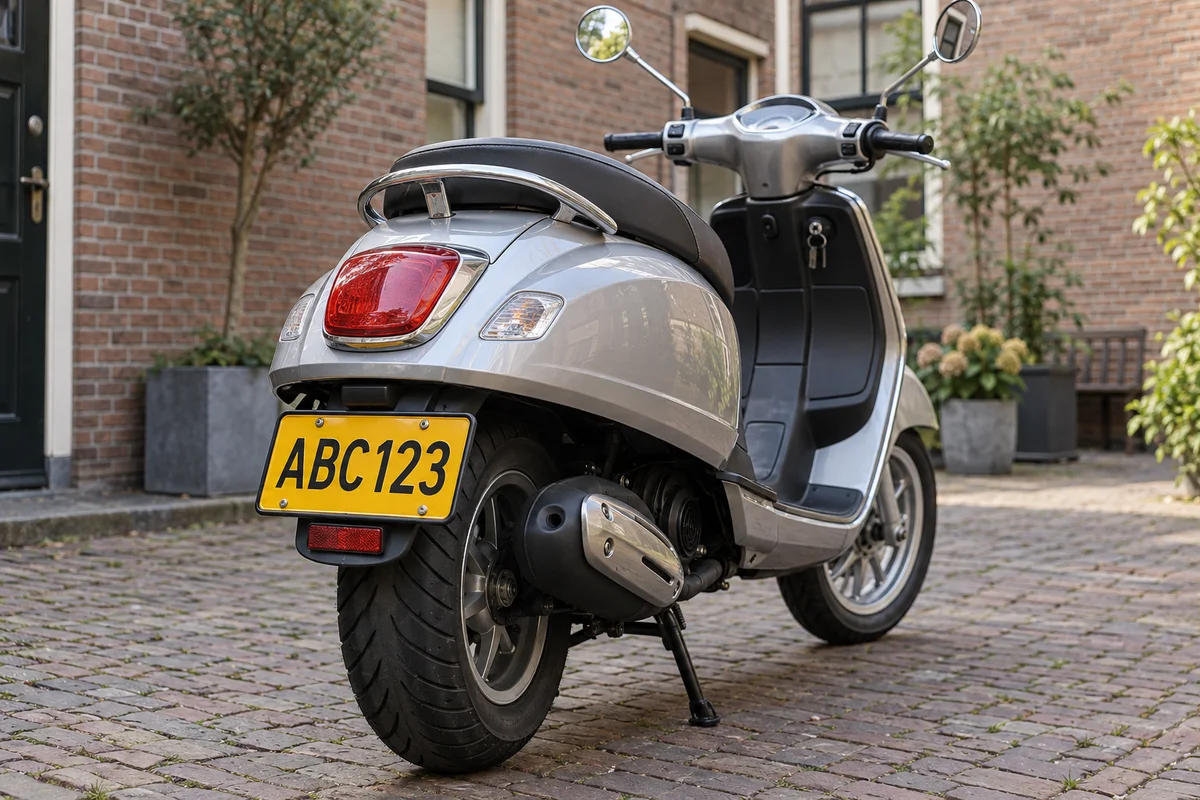
This lesson covers ordinary two-wheel mopeds and scooters with yellow plates. “Scooter” describes a design, not a legal category: a light moped or motorcycle can look similar. Microcars have different road-position rules.
An ordinary moped uses the compulsory shared cycle/moped path (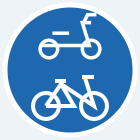 Shared cycle/moped path (G12a)). Without one, it uses the carriageway. A compulsory cycle path showing only a bicycle (
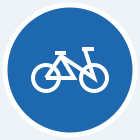 Compulsory cycle path (G11)) is not a shared cycle/moped path: an ordinary moped may not ride there. Read supplementary signs and access restrictions; red surfacing alone is insufficient.
The shared cycle/moped path limit is 30 km/h inside and 40 km/h outside built-up areas. The carriageway ceiling is 45 km/h, both inside and outside built-up areas. An expressway or motorway is not an allowed route for this ordinary moped.
A lower applicable limit still binds: on the carriageway in a 30 zone, at most 30; in an erf, at most 15. A 50 sign does not allow a moped to ride at 50. Design speed is not an instruction to maintain it. Slow down in unclear situations.
Rider and passenger wear properly fitting, fastened, approved moped helmets. An ordinary bicycle helmet or a helmet with only NTA speed-pedelec approval is insufficient for this ordinary moped. The rider is at least 16 with AM; a valid car or motorcycle licence also suffices. AM4 is restricted to microcars. Liability insurance and registration documents are required.
As a car driver, anticipate moped position and speed. Keep distance, check mirrors and blind spots before turning and let traffic continuing straight on the same road go first. A yellow plate gives you no extra priority and a slow vehicle does not justify unsafe overtaking.