Disability vehicles & mobility scooters
Recognise the vehicle category, permitted road space and speed limits. A mobility scooter is not a microcar.
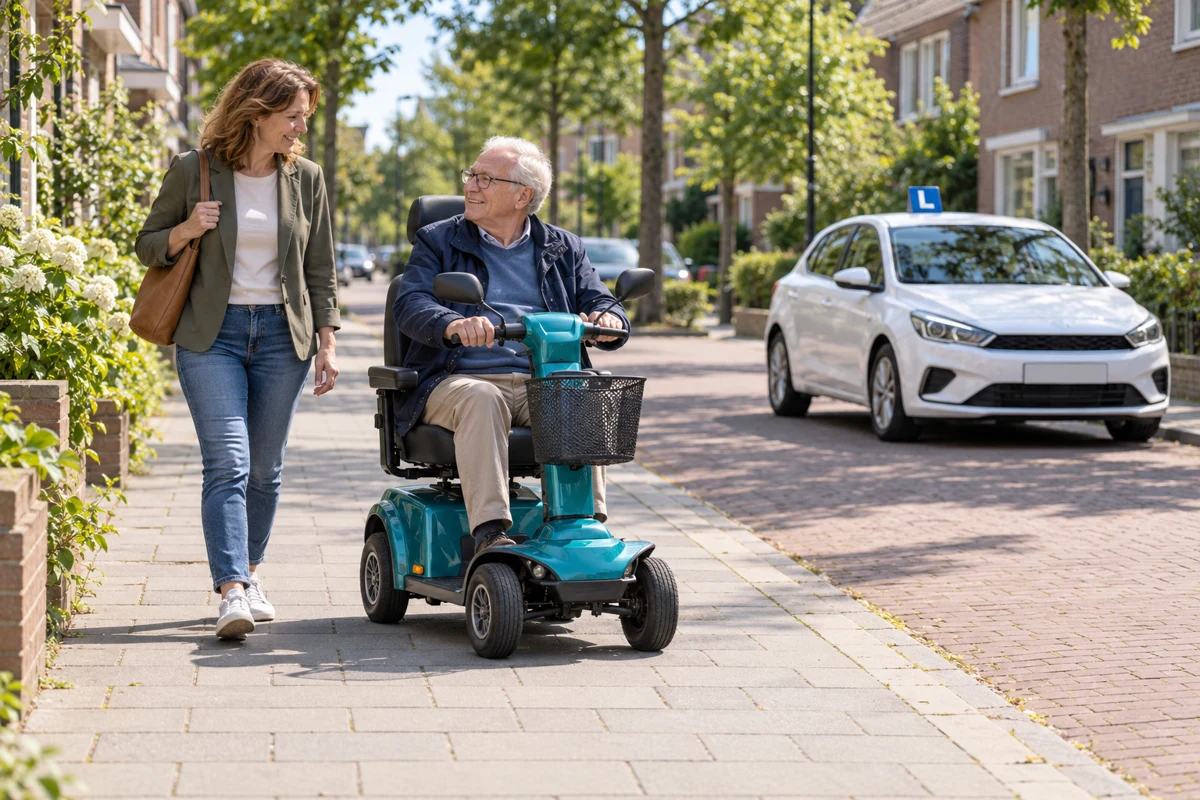
A disability vehicle is designed to carry a person with a disability, is at most 1.10 metres wide and is not a moped. It may be unpowered; if powered, its design speed is at most 45 km/h. Examples include wheelchairs, mobility scooters and purpose-built enclosed disability vehicles. Being small or capable of 45 km/h alone does not establish this category.
The user may use the pavement, footpath, cycle track, combined cycle/moped track or carriageway. Their location affects the applicable rules. Pedestrian rules also apply on pavements or footpaths and when crossing between them. On the carriageway, treat the user as a driver at an uncontrolled junction.
For a powered disability vehicle, the upper limits are: 6 km/h on a pavement or footpath; 30 km/h on cycle or combined cycle/moped tracks within built-up areas; 40 km/h on those tracks outside built-up areas; 45 km/h on the carriageway. Any applicable lower limit still applies. A scooter designed for only 15 km/h must not be modified merely to reach 45.
A disability vehicle may not use an expressway or motorway. A powered disability vehicle does not require a driving licence, but does require third-party liability insurance. No registration plate is required; the insurance plate or sticker is different from a vehicle registration plate.
Powered disability vehicles generally have a minimum user age of 16, with exemptions possible. The age exception specifically covers electrically powered vehicles that cannot exceed 10 km/h. This differs from selecting a 10 km/h setting on a faster mobility scooter.
As a car driver, anticipate low speed, limited visibility and vulnerability. Allow space, reduce speed early and overtake only when safe and permitted. A mobility scooter approaching from the right on the carriageway may have priority. At an unsignalised zebra, let a disability-vehicle user crossing or clearly about to cross pass; recognisable convoys and processions have specific exceptions.