Other road users
Recognising a speed pedelec: what drivers need to know
A speed pedelec looks like a bicycle but follows moped rules. Learn where it belongs and how to judge its approach more carefully.
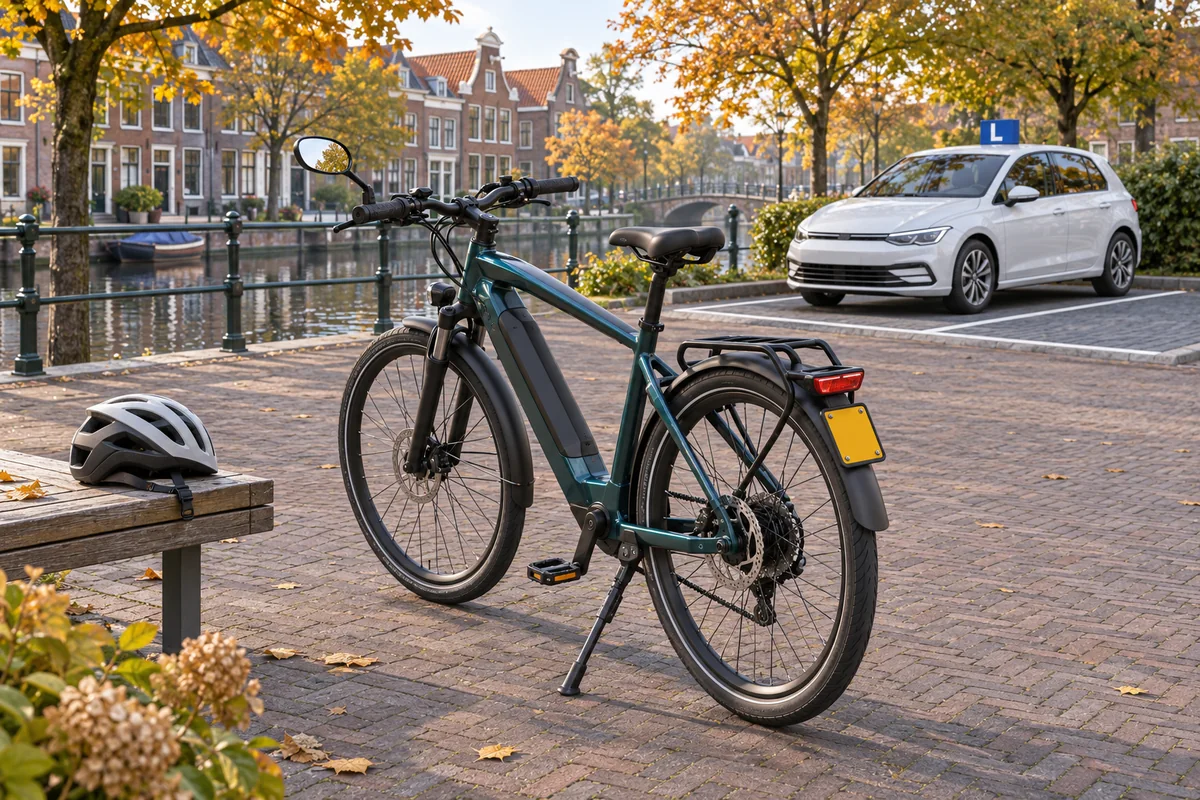
Pedals do not tell the whole story
You see pedals and think of an ordinary bicycle. Look more closely: a speed pedelec has a yellow registration plate and a left rear-view mirror. It is legally a moped. An ordinary electric bicycle provides pedal assistance up to 25 km/h; a speed pedelec can provide assistance up to 45 km/h. That does not mean the rider is always travelling at that speed.
Where might you encounter one?
A speed pedelec uses a combined cycle/moped path or the carriageway, the part of the road used by cars. An ordinary cycle path is different from a combined cycle/moped path: without a valid exception, a speed pedelec must not use the ordinary cycle path. Check local signs and any exceptions; red surfacing alone does not establish which rule applies.
Do not assume a fixed speed
The usual upper limits are 45 km/h on the carriageway, 30 km/h on a combined cycle/moped path inside a built-up area and 40 km/h on that type of path outside a built-up area. A lower applicable limit still applies. For example, a speed-pedelec rider on the carriageway in a 30 km/h zone may travel at no more than 30 km/h, not 45 km/h. These numbers are legal limits, not measurements of an approaching rider’s actual speed. Watch the real movement and distance.
Appearance does not establish approval
The rider must be at least 16 and meet the other requirements, including an appropriate licence and motor vehicle third-party liability insurance. This insurance concerns liability for damage to others. An approved speed-pedelec helmet or approved moped helmet is required. Shape alone does not prove a helmet’s approval. As a driver, you also cannot tell from someone’s appearance whether all requirements have been met.
Turn looking into a deliberate check
Imagine you want to turn and see a two-wheeler approaching in your mirror. Do not decide based solely on the label “bicycle”. Check the situation again and apply the rules for turning and giving way. Priority follows from the actual traffic situation, not just speed or vehicle shape. Do not guess when you are unsure there is a safe opening. This is an observation strategy, not a new priority rule.
Practise the rule in another situation
Read the lessons on mopeds, speed and priority. Then practise the speed-pedelec questions and explain which detail determines each answer. Is it the type of path, helmet approval or a lower limit? This helps you apply a rule instead of merely recognising a picture. The cover illustration is decorative and does not show a measured speed.