Safe and responsible driving
Keeping your distance: look beyond the car ahead
A safe following distance is more than a number. Practise assessing visibility, space and speed together, including in rain and slippery conditions.
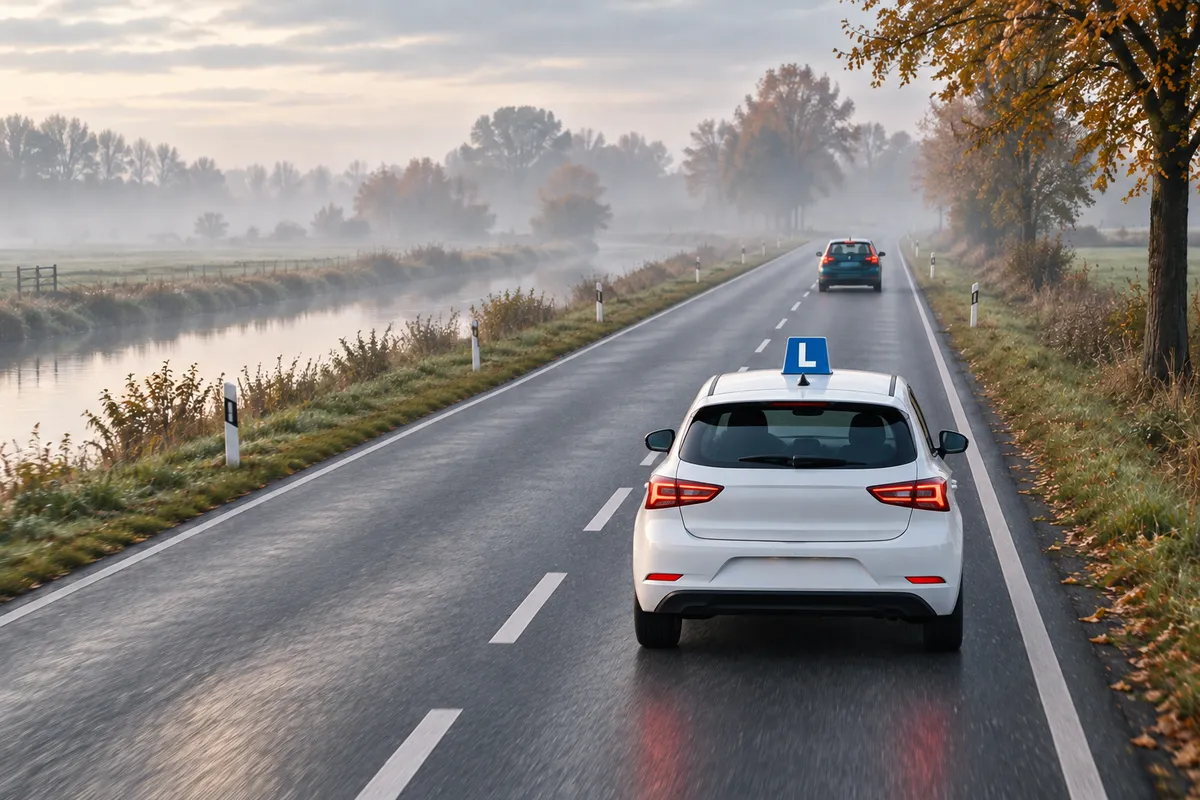
Three questions instead of one number
You are following another car. Looking only at the gap to its rear bumper is not enough. Ask yourself three questions: can I react in time if it brakes, can I clearly see the road ahead, and does my speed suit what I can see? Use these questions during online driving theory study and driving lessons. The aim is not to recognise a picture, but to explain which risk determines your decision.
Following distance and visible distance are different
Following distance is the gap between your vehicle and the vehicle ahead. The clear visible distance is the length of road you can see and which is unobstructed. The road rule requires you to be able to stop within that clear, visible distance. A large gap to the car ahead is therefore not sufficient if you approach a blind bend too fast. Assess both the vehicle ahead and how the road develops.
Practice situation 1: visibility deteriorates
Imagine the car ahead continues driving, but mist reduces your view of the road. Its pace is not proof that your pace is safe. Reduce speed in good time and leave room to react. In a practice question, consider not just the gap between the cars, but the length of road you can actually see. No single speed is automatically safe in every type of poor visibility.
Practice situation 2: rain after a dry spell
Rain can cause slippery conditions outside winter too. Rijkswaterstaat warns about summer slipperiness and advises extra distance, reducing speed where necessary and avoiding unnecessary lane changes. During hazard perception practice, consider how the road surface affects your ability to brake. A familiar route or a modern car does not remove those conditions.
Turn a mistake into a better explanation
Got a distance question wrong? Do not just write down the correct answer. Complete this sentence: “I needed more space or a lower speed because …” Then identify the specific detail: restricted visibility, a changing surface or traffic that may slow down. Change one part of the situation and explain your response again. This is a practice method, not a fixed formula that solves every traffic situation.
Your next step: view, space, pace
View: how much clear road can I see? Space: do I have enough following distance? Pace: can I stop within the clear, visible distance? Read the Speed & distance lesson and then practise different situations. Discuss any uncertainty with your driving instructor. ViaTheoria offers free driving theory learning and practice in Dutch and English; a good practice score does not guarantee safe decisions or a pass.